Pre-Cuts Explained: Charm Packs, Jelly Rolls, Layer Cakes
You walk into your local quilt shop with a simple plan: pick up a bit of fabric, maybe a neutral background, and head home. Then you turn the corner and there it is — the wall of pre-cuts. Rows of charm packs, jelly rolls and layer cakes stacked in every colourway imaginable, each bundle wrapped like a little gift, each one promising a finished quilt without hours of cutting. We’ve all stood there, picking up a jelly roll, putting it down, picking up a layer cake instead, and wondering which one actually suits the project in our head. The good news is that pre-cuts are one of the most quilter-friendly inventions of the modern fabric world, and once you understand the sizes, the brands and the possibilities, that wall stops being overwhelming and starts being a shortcut.
What Are Pre-Cuts and Why Do We Love Them?
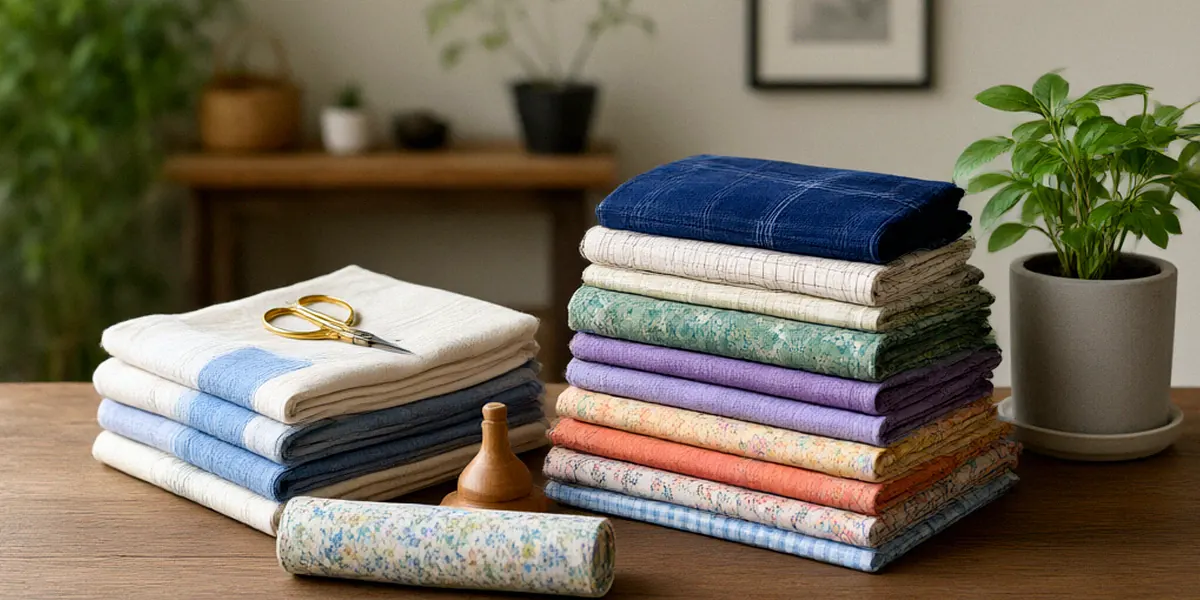
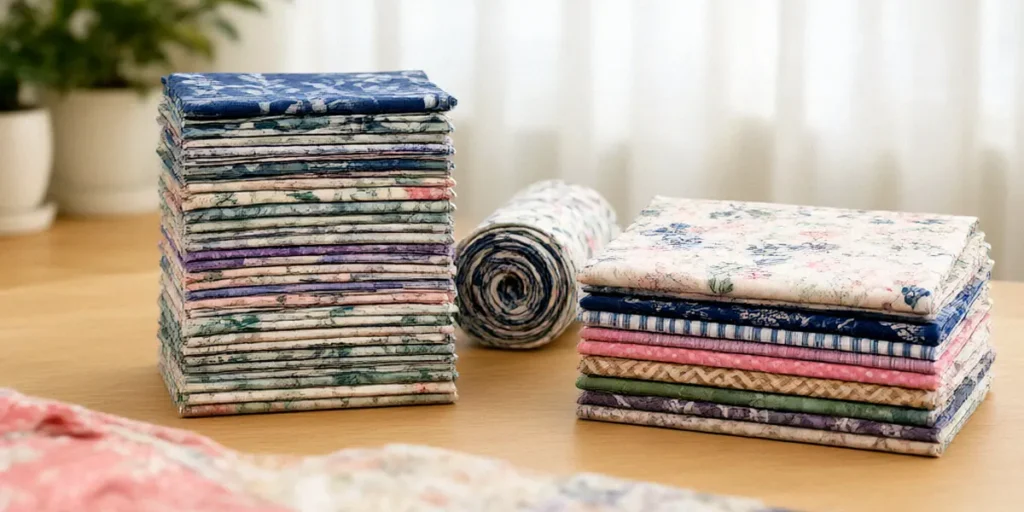
Pre-cuts are bundles of fabric that have already been cut to specific, standardized sizes by the manufacturer. Instead of buying yardage and spending an evening at your rotary cutter, you open a package and start sewing. Because each bundle usually comes from a single fabric collection, the colours and prints are already coordinated by the designer — no guessing whether that green really matches that floral.
For Canadian quilters, pre-cuts are widely available. Fabricland, the major Canadian fabric retailer with locations from coast to coast, stocks pre-cuts in its quilting departments, and online shops like Mad About Patchwork, based in Ontario, carry an excellent rotating selection of bundles from major manufacturers. Whether you shop in person or online, you can usually find exactly the size and collection you need without waiting on a cross-border shipment.
The Benefits of Using Pre-Cuts
- Time saved: No washing, pressing and cutting yardage before you begin — the prep work is done.
- Coordinated colour: Every piece comes from one collection, so your quilt looks pulled together automatically.
- Less fabric waste: You buy the amount you need rather than extra yardage that ends up in the stash.
- Beginner friendly: Consistent sizes mean fewer cutting errors and easier piecing for new quilters.
- Portable: A charm pack or jelly roll fits in a tote bag, making them ideal for retreats and sewing nights.
Common Pre-Cut Manufacturers We Trust
Moda Fabrics popularized the modern pre-cut system and remains the most recognizable name on the shelf. Robert Kaufman and Benartex both produce extensive pre-cut programs, and Northcott Fabrics, a Canadian company, manufactures pre-cuts as well — a nice detail for quilters who like to support domestic production. If you’re browsing online, checking the manufacturer tells you a lot about the cut sizes and the number of pieces you’ll receive.
Charm Packs: The 5-Inch Squares
A charm pack contains 42 squares measuring 5 x 5 inches, typically all from one fabric collection. That’s enough variety to build a full quilt top without repeating a print too often. Moda Fabrics is the brand most associated with charm packs, though most major manufacturers now offer equivalent 5-inch square bundles under their own names.
Charm packs are our favourite starting point for beginners because the squares are large enough to handle easily but small enough that a whole quilt comes together quickly. They’re also perfect for small projects where you want variety without committing to yardage.
What’s Included in a Charm Pack?
Expect 42 squares, each 5 x 5 inches, usually representing every print in a collection plus a few duplicates. Some packs include a mix of light, medium and dark values, which makes planning a layout easy. Always check the label — a few manufacturers sell 40-square packs instead of 42, which matters if your pattern specifies an exact count.
Project Ideas for Charm Packs
- Simple patchwork baby quilts in a 6 x 7 grid
- Table runners and placemats
- Zippered pouches and tote bags
- Half-square triangle quilts using the two-at-a-time method
- Fabric-covered notebook covers and mug rugs
Jelly Rolls: The 2.5-Inch Strips
A jelly roll is a bundle of 40 strips, each 2.5 inches wide by roughly 44 inches long — the full width of fabric. Those long strips make jelly rolls ideal for strip quilting, where you sew strips together into panels and then sub-cut them into blocks. They’re also a convenient source of binding strips for a finished quilt.
Canadian quilters often reach for jelly rolls when they want a quick quilt top: strip piecing goes fast, and the coordinated collection does the colour work for you. Benartex and Robert Kaufman both produce reliable jelly roll lines, and you’ll find them regularly at Canadian retailers.
Understanding Jelly Roll Dimensions
Each strip is 2.5 inches by approximately 44 inches, and a standard roll contains 40 strips — about 2.75 metres of fabric in total. Because the strips are cut across the full width of the fabric, they include the selvedge on some rolls, so trim those edges before piecing. Note that “junior” jelly rolls contain fewer strips, often 20, so confirm the count before starting a pattern.
Popular Patterns for Jelly Rolls
- Jelly roll race quilts, which can be finished in an afternoon
- Log cabin blocks built from consecutive strips
- Strip-pieced nine-patch quilts
- Binding for a queen-size quilt (one roll is usually enough)
- Simple striped table runners and pillow covers
Layer Cakes: The 10-Inch Squares
A layer cake holds 42 squares of 10 x 10 inches, again usually from a single collection. Because the squares are large, layer cakes are excellent for big, bold blocks, appliqué backgrounds and quilts that need to show off a print rather than chop it into small pieces. You’ll sometimes see them labelled simply as “10-inch squares,” which is exactly what they are.
Northcott Fabrics, a Canadian manufacturer, produces layer cakes and other pre-cuts, which means Canadian quilters can often find domestically produced bundles at their local shop or online.
What Can You Make with a Layer Cake?
Layer cakes shine in patterns that use large squares or rectangles: a simple 6 x 7 grid makes a generous lap quilt with no cutting beyond trimming. They’re also wonderful for appliqué — the 10-inch square gives you a substantial background for a floral or seasonal design. Cut each square into four 5-inch squares and you effectively have a charm pack’s worth of fabric, which makes layer cakes a versatile stash staple.
Layer Cakes vs. Charm Packs: Size Comparison
A charm pack gives you 42 squares at 5 x 5 inches; a layer cake gives you 42 squares at 10 x 10 inches. That’s four times the fabric per piece and roughly four times the total yardage. In practical terms, one layer cake can be sub-cut into four charm packs’ worth of squares, but a charm pack can never become a layer cake. If you’re unsure which to buy, think about block size: small pieces suit charm packs, large statement blocks suit layer cakes.
Other Pre-Cuts You Should Know
Beyond the big three, there’s a whole family of pre-cuts worth knowing. Fat quarters are the most familiar — a quarter-yard cut that measures approximately 18 x 22 inches, sold individually or in bundles. Honey buns contain 1.5-inch strips, and mini charm packs hold 2.5-inch squares. Each has its own best use.
Fat Quarters: The Versatile Option
Fat quarters are sold individually at most Canadian quilt shops, including The Quilting Bee in Ontario, which makes them ideal when you want to choose your own colours rather than commit to a designer collection. They’re generous enough for appliqué, bag making and background fabric, and a bundle of eight to twelve fat quarters is plenty for a throw-size quilt.
Honey Buns and Mini Charms: Smaller Cuts
Honey buns give you 40 strips at 1.5 x 44 inches — perfect for narrow sashing, piano-key borders and delicate strip quilting. Mini charm packs contain 42 squares at 2.5 x 2.5 inches, which are wonderful for postage-stamp quilts, doll quilts and small pieced accents. Both are great ways to use up leftover space in a project without buying yardage.
How to Choose and Use Pre-Cuts
Start with your pattern, not the fabric. Most modern patterns specify the pre-cut they’re designed for, and matching that specification saves a lot of frustration. If you’re designing your own project, work backwards from the finished size: charm packs for small quilts and accessories, jelly rolls for fast strip-pieced tops, layer cakes for large blocks and appliqué.
One practical note for Canadian shoppers: if you order pre-cuts from US retailers, you may face customs fees, duties and brokerage charges on delivery. Factor that into the price before you click buy, and check whether the shop offers a Canadian-friendly shipping option. Buying from Canadian retailers avoids the surprise entirely.
Matching Pre-Cuts to Patterns
- Charm pack patterns usually call for one or two packs plus background yardage.
- Jelly roll patterns typically need one roll plus binding and backing fabric.
- Layer cake patterns often use one cake for a lap quilt and two for a larger throw.
- Fat quarter patterns vary widely — always read the fabric requirements carefully.
Where to Buy Pre-Cuts in Canada
Fabricland is the easiest starting point for in-person shopping, with pre-cuts in most quilting departments. For online selection, Mad About Patchwork in Ontario carries a strong range of bundles and ships across the country. Quilts Etc. is another Canadian option worth checking, and local shops like The Quilting Bee in Ontario are great for browsing fat quarters and specialty cuts. Supporting Canadian retailers means faster shipping and no customs surprises.
FAQ
Are pre-cuts more expensive than buying yardage?
Per metre, pre-cuts usually cost slightly more than equivalent yardage because you’re paying for the cutting and packaging. However, most quilters find the time saved and the reduced fabric waste more than make up the difference, especially for small projects.
Do I need to pre-wash pre-cuts?
We generally don’t pre-wash pre-cuts. The pieces are small and fray easily in the wash, and most manufacturers use quality cotton with minimal shrinkage. If you’re concerned about colour bleeding, test a single square in warm water before washing the whole bundle.
Can I mix pre-cut sizes in one quilt?
Absolutely. Mixing a charm pack with a jelly roll, or a layer cake with fat quarters, is a common way to add variety. Just make sure your pattern accounts for the different sizes so your seam allowances line up correctly.
What’s the difference between a jelly roll and a honey bun?
A jelly roll contains 2.5-inch strips, while a honey bun contains 1.5-inch strips. Both are 44 inches long and typically come in bundles of 40, but the narrower honey bun strips suit finer piecing and delicate borders.
Where can Canadian quilters buy pre-cuts without customs fees?
Shopping with Canadian retailers like Fabricland, Mad About Patchwork, Quilts Etc. or The Quilting Bee avoids customs fees entirely. If you do order from the US, check the retailer’s shipping policy and expect possible duties and brokerage charges on delivery.
Pre-cuts take the two most tedious parts of quilting — choosing coordinating fabric and cutting it all to size — and hand them back to you as a neat, wrapped bundle. Whether you start with a charm pack for a baby quilt, a jelly roll for a fast strip quilt, or a layer cake for a bold appliqué project, there’s a pre-cut that fits the way you like to sew. Next time you’re in a Canadian quilt shop, pick up a size you’ve never tried before and see where it takes you.